Grand narratives of limitless creativity
In the promotional video introducing OpenAI's video model Sora 2 (now discontinued), an AI-generated Sam Altman looks into the camera and talks about enabling everyone to "push the limits of their imagination." Behind him, jockeys race giant ducks across a pool in a packed arena. The hectic release of generative visual AI models has been accompanied by a promise of boundless imagination, with commercial image and video generation tools promoted through grand narratives of limitless creativity. AI-enabled image generators are often described as magical [↘ Laba, 2024], and the technology behind them is surrounded by a discourse of "enchanted determinism" [↘ Campolo and Crawford, 2020].
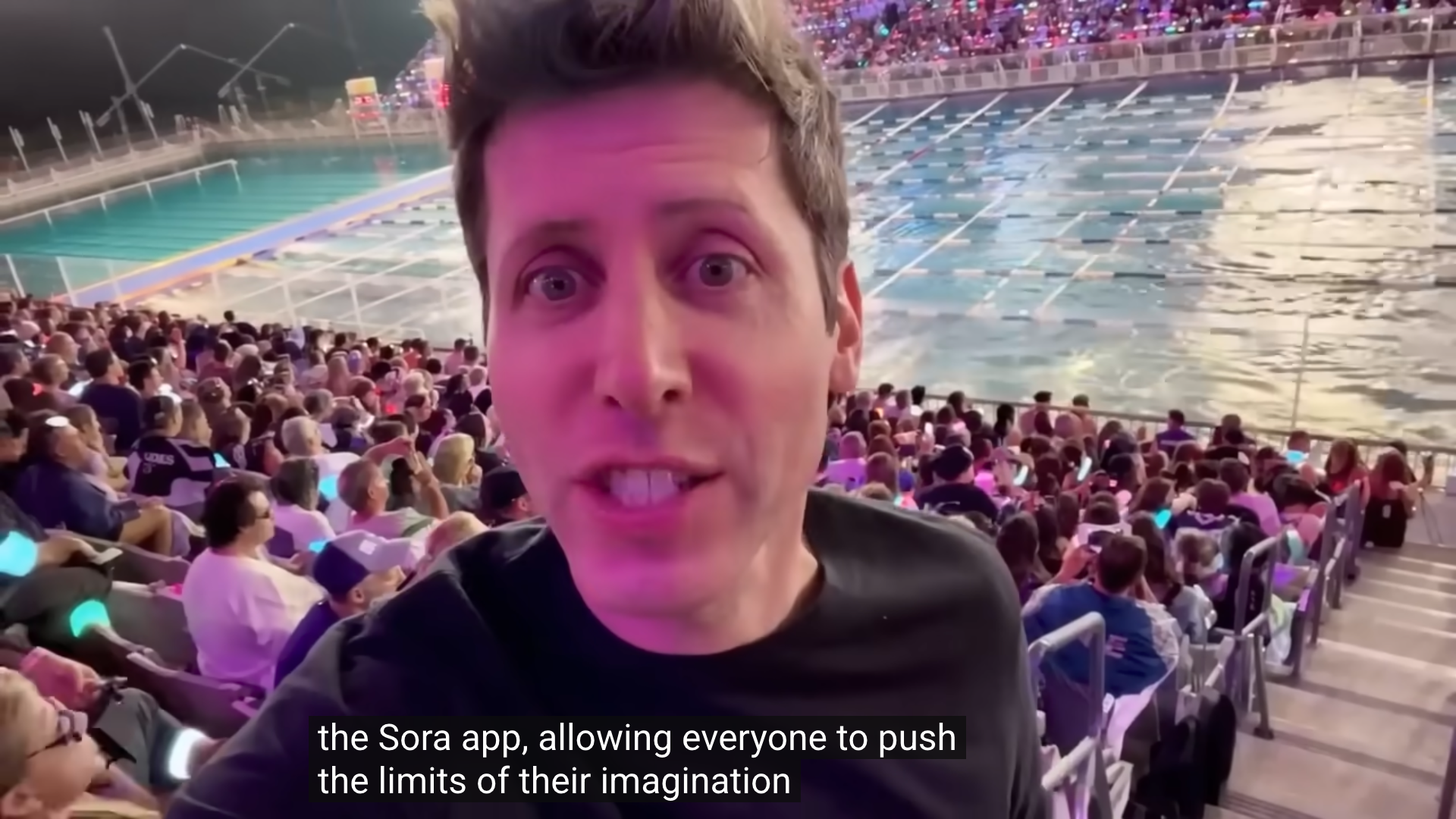
[↘ Sora app introduction video]
Against this promise of magical and unrestricted imagination, users find themselves dealing with an image-making process that feels clunky, guided, sanitised, and otherwise moderated. In practice, generative image-making is steered through interfaces, silently shaped in the backend, and performatively denied through various forms of refusal to generate. Interfaces and their affordances guide the image-making process through the behaviours they promote or restrict, and interaction patterns enable certain workflows while hindering others. Opaque and silent backend processes (e.g., shadow prompting, prompt enhancement, or revised prompts) align user requests with what platform holders deem acceptable. In addition, generative systems intervene performatively with refusals, flags, alerts, or temporary bans in response to uncomfortable or controversial prompts.
Moments of friction as analytical opportunity
At the same time, users of generative AI develop strategies to make sense of and react to the opaque ways in which the image-making process is guided, limited, and constrained. Within prompting communities, users share their experiences with the models, reporting moments of friction with the models, odd behaviors, trying to infer general rules from individual cases, or sharing strategies to bypass the opaque and erratic limits of the systems.
It is in these moments of friction, where the tension between the limits of the models and the infinite possibilities they promise becomes visible, that we can best observe the relationship between humans and unpredictable machines. In apparently banal complaints about refusals, poor outputs and failed generations, we glimpse the imaginaries taking shape around AI — and around our relationships with it.
Research question
How do communities of image makers collectively make sense of the opaque constraints of visual AI systems, and what shared strategies do they develop to negotiate and circumvent them?
We look at how an online community of image makers (↘ r/GeminiAI) makes sense of a model's refusals and malfunctions: the explanations they offer, but also the different characterisations of the model that emerge from those explanations, and how these feed into distinct imaginaries of what a generative model is. At the same time, we observe the practical strategies users deploy in reaction to the model as they imagine it.
What emerges is a landscape where Gemini is at times perceived as a nerfed and limited technical object, an extremely paranoid commercial product, a (bad) prompt interpreter, a limited and biased training set, or even an erratic, hostile and stubborn person. Looking at the strategies users deploy in response to these characterisations, what emerges is a repertoire of vernacular creativity, ranging from inventive prompting strategies to interface hacking, to argumentative postures in which users debate with the model with a mix of curiosity and resentment.
Methods and data
To answer the research question, we collected every post published on ↘ r/GeminiAI throughout 2025, retrieved through ↘ Arctic Shift. Each post was screened with the OpenAI batch API and flagged for three dimensions: image generation, problems or friction with the model, and adult content. We kept only posts flagged positive on the first two, to avoid an exclusively sexual-content-related dataset.
From this pool, we ranked posts by comments and likes, and close-read the top 100 in each ranking, selecting cases that documented a user's request, the model's reaction and, where possible, how the user worked around it; that were varied enough to avoid repetition; and that had sparked discussion among users. This left a working set of 118 unique posts. Each post was then coded manually. For every case, we extracted:
- ↘ the user request – what the user was trying to achieve
- ↘ the model behaviour – how the model responded
- ↘ the adjective the user used to describe that behaviour
- ↘ the strategy – an action the user took, or was advised to take, to work around an unwanted model behaviour
Different users often described similar behaviours in different words, so we consolidated these adjectives into a shared vocabulary and grouped them into clusters. Strategies were clustered the same way, by similarity of action. We then attributed each cluster to the aspect of the system that made those strategies possible in the first place. These clusters of adjectives and strategies are the material behind the Sense-making and Reacting pages.
Credits
This project was carried out and curated by Gabriele Colombo and Anna Cattaneo, at DensityDesign Lab, Department of Design, Politecnico di Milano.